
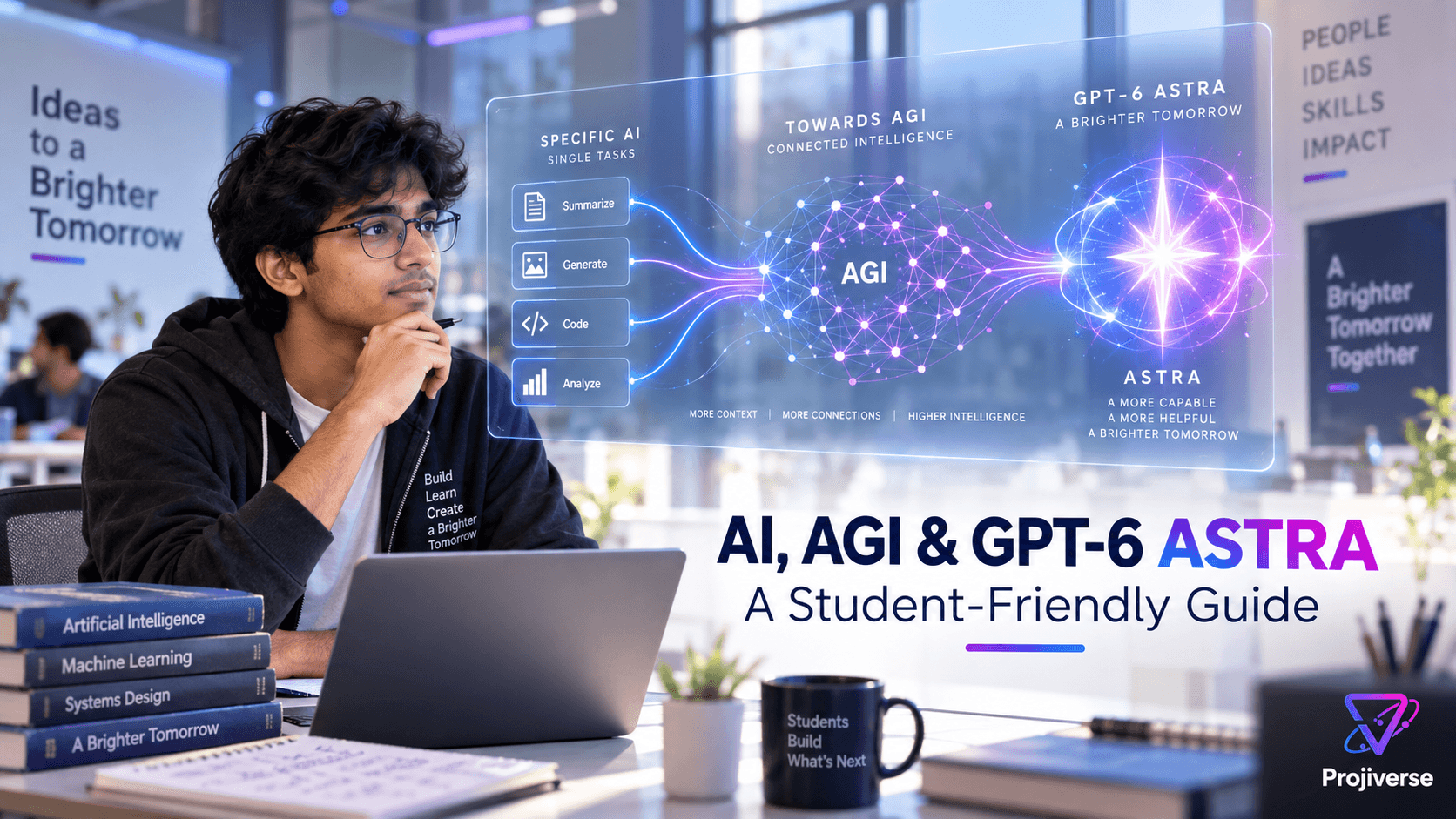
Artificial intelligence is changing how students learn, research, code and build projects. With the release of GPT‑6 Astra, AI can now handle more complex tasks, operate software and complete longer workflows.
But does this mean AGI has arrived?
Let's understand AI, AGI and GPT‑6 Astra in simple terms — without complicated technical language.
What is Artificial Intelligence?
Artificial Intelligence, or AI, refers to computer systems designed to perform tasks that normally require human intelligence.
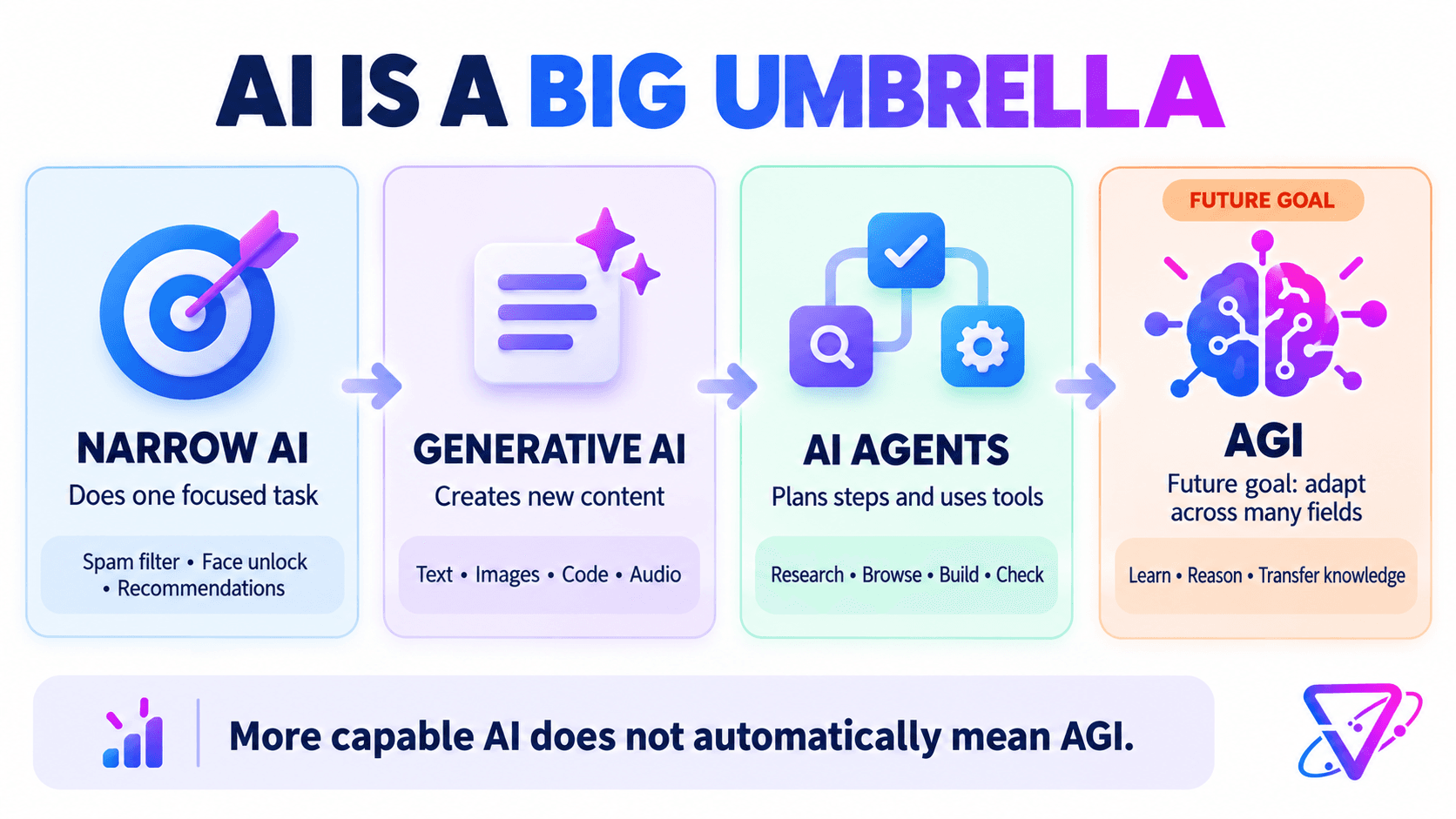
AI is a broad term — different AI systems have very different levels of capability.
Understanding the Different Types of AI
Performs one specific task
Spam filters, face unlock, recommendations
Creates new content
Text, images, code, audio, presentations
Plans steps, uses tools, completes workflows
Research agents, coding agents, browser automation
Learns & adapts across many fields (future)
No system officially recognised as AGI yet
Narrow AI
Narrow AI is trained or designed for a focused task.
For example, a recommendation system can suggest movies based on your interests, but it cannot independently design a college project, conduct research and prepare you for a viva. It may perform its assigned task extremely well, but its intelligence is limited to that area.
Generative AI
Generative AI creates new content based on instructions. You can ask it to:
- Explain a difficult topic
- Write an email
- Generate program code
- Create an image
- Summarise a document
- Prepare practice questions
ChatGPT is a well-known example of generative AI.
AI Agents
An AI agent goes beyond producing a single response. It can plan a task, use tools, perform actions, review the results and continue working.
For example, an AI project agent could:
- Understand a project requirement.
- Research possible solutions.
- Create an architecture.
- Generate and test code.
- Identify errors.
- Prepare documentation.
- Create viva questions.
An agent is still an AI system — it doesn't automatically become AGI simply because it can use tools or complete multiple steps.
What Is AGI?
Artificial General Intelligence, commonly called AGI, is the idea of an AI system that can learn, reason and adapt across many different fields instead of being limited to a particular task.
A normal AI tool may be excellent at one task. AGI would be able to learn many different tasks and apply knowledge from one area to another.
For example, a truly general system might learn software development, understand business strategy, study biology — then apply ideas from all three areas to solve a new problem, with minimal specialised training.
AGI does not necessarily mean:
AGI is mainly about the breadth, flexibility and adaptability of intelligence.
Has AGI Already Been Achieved?
There is currently no universally accepted test that proves a system has achieved AGI. Different researchers and organisations define AGI differently — passing a difficult benchmark does not automatically prove that an AI possesses human-level general intelligence.
As of 6 September 2026, OpenAI describes Astra as its most intelligent and aligned model — not as confirmed AGI. Read OpenAI's announcement →
What Is GPT‑6 Astra?
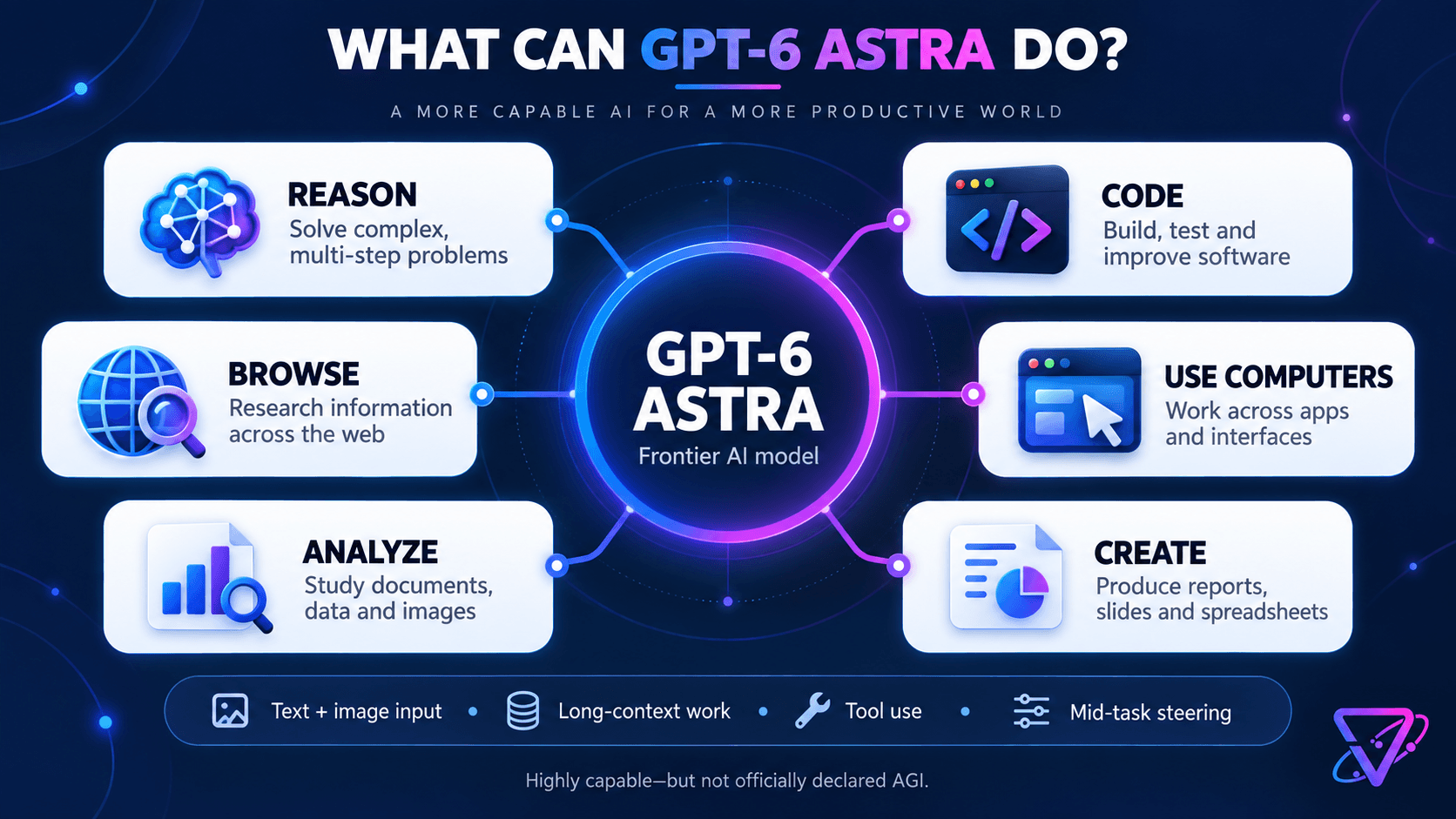
GPT‑6 Astrais OpenAI's newly released frontier AI model, designed for demanding, end-to-end work involving reasoning, coding, research, computer use and professional content creation.
Students may see Astra as an available model inside ChatGPT, Codex or other supported OpenAI experiences, depending on their subscription, account rollout and workspace settings. OpenAI began rolling out Astra to ChatGPT Plus, Pro, Business and Enterprise users, as well as through its API and selected cloud platforms. Check official availability →
What Can GPT‑6 Astra Do?
1. Solve Complex Problems
Breaks a complicated problem into smaller steps, analyses available information and works toward a solution.
- Understanding project requirements
- Comparing possible technologies
- Designing application architecture
- Troubleshooting technical problems
2. Build & Improve Software
Explores a codebase, implements features, identifies bugs, runs tests and verifies results.
- Frontend/backend communication
- Database design & APIs
- Cloud deployment
- Testing, debugging & security
3. Browse & Conduct Research
Searches for relevant information, compares sources and prepares structured findings.
- Literature reviews
- Technology comparisons
- Feasibility studies
- Finding official documentation
4. Work Across Applications
Stronger computer-use capability — can interact with websites and apps to complete multi-step workflows.
- Organising information
- Updating documents
- Verifying a website feature works
5. Analyse Text, Data & Images
Reads documents, screenshots, diagrams, charts and code — together, connecting the pieces.
- Requirement documents
- Architecture diagrams & DB schemas
- Error screenshots
- Source code
6. Create Professional Deliverables
Produces polished, structured documents and can follow existing templates.
- Project reports & presentations
- Technical documentation
- Testing plans
- Viva & interview questions
7. Handle Long Projects
A 1,050,000-token context window — the amount of information it can consider at once.
- Very large requirement sets
- Full documentation sets
- Large source-code bases, without losing earlier details
8. Accept Instructions Mid-Task
Supports mid-task steering — you can add a correction or requirement without it forgetting the broader objective.
- Live course-correction
- No need to restart a long task
- Keeps the overall goal in view
AI-generated code must still be reviewed, tested and understood before it's used in an academic project. Students should always verify sources and provide proper citations instead of submitting AI-generated research without checking it.
Is GPT‑6 Astra the Same as AGI?
No — not based on OpenAI's official description.
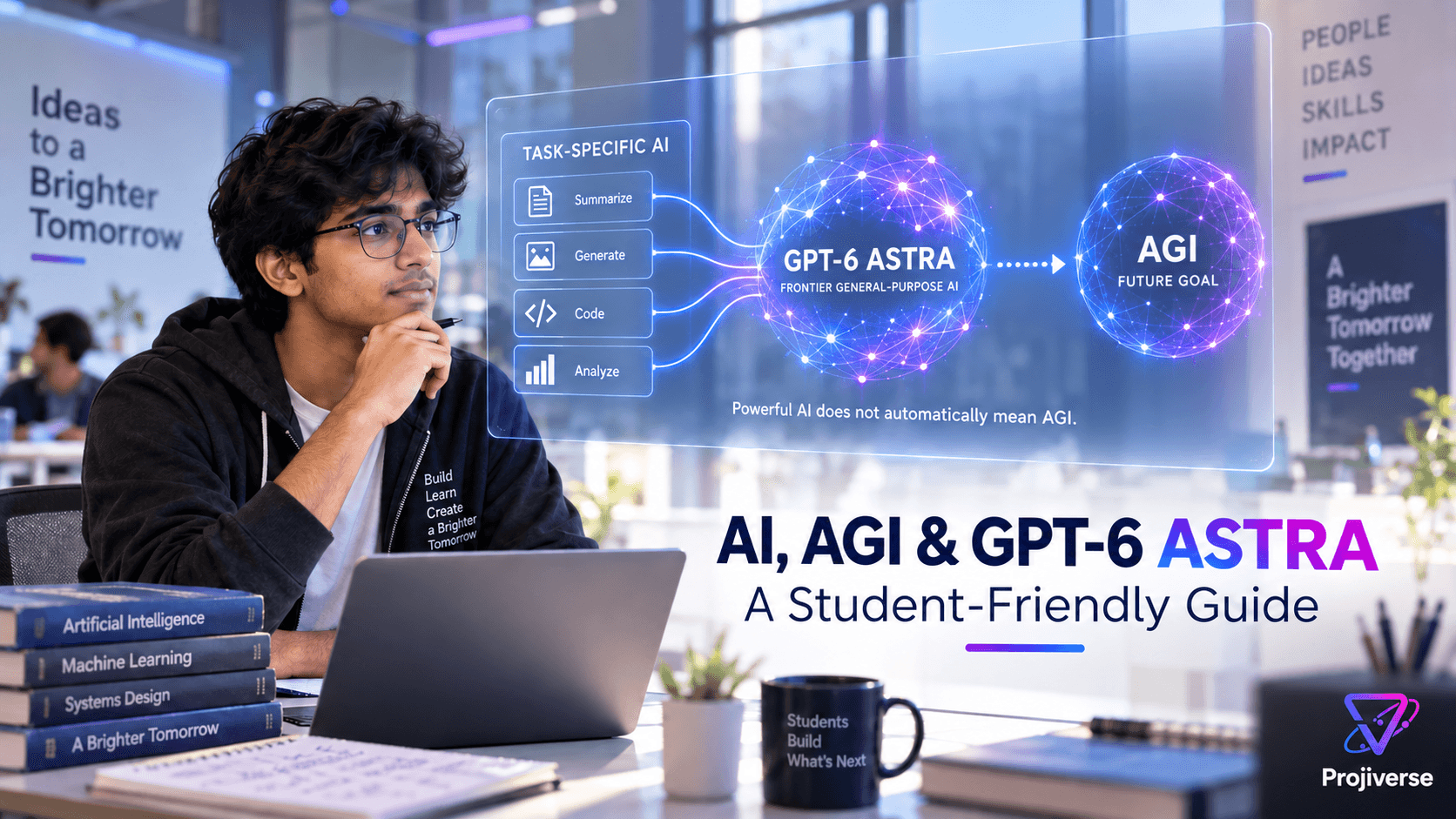
GPT‑6 Astra is a highly capable, general-purpose frontier model. It can reason across different subjects, use tools and complete complex workflows. However, those abilities alone do not prove AGI.
GPT‑6 Astra represents significant progress toward broader and more adaptable AI, but it has not been officially declared AGI.
Important Terms, Explained Simply
The AI system that processes your instructions and generates a response.
The question, instruction or goal you provide to an AI.
A small unit of text processed by an AI model.
The amount of information the model can keep available while working.
The process of analysing a problem and deciding how to approach it.
The ability to use functions such as browsing, coding environments, file search or computer control.
An AI-powered system that plans steps, uses tools and works toward a goal.
An AI system that can understand more than one type of input, such as text and images.
Training and safeguards intended to make an AI follow human instructions, respect boundaries and behave safely.
How Can Students Use Astra Responsibly?
Students can use advanced AI as a mentor, but not as a replacement for learning. A responsible workflow is:
The objective should not be to submit a project generated by AI. The objective should be to use AI to understand the project more deeply.
How Projiverse Supports Students
Projiverse helps B.Tech, B.Sc., BCA, MCA, M.Tech and final-year students move through the complete project journey. Students can receive support for:
Do not just submit a project. Understand it, build it and present it with confidence.
Final Thoughts
GPT‑6 Astra shows how quickly AI is progressing — from answering questions to reasoning, using tools and completing complex workflows. It's an important advancement, but students should avoid treating every powerful AI system as AGI. The real value of these technologies comes from learning how to use them thoughtfully, responsibly and effectively.
For students, the future is not about allowing AI to do everything. It's about combining human curiosity, subject knowledge, practical experience and responsible AI assistance to build something meaningful.