

Imagine a customer sends you this message: “I was charged twice. Can someone check?”
You could ask a large language model to read it, explain what it means, and write a response. But your app may not need a paragraph yet. It might only need to know which team should receive the ticket.
That small distinction is the idea behind Jev, TypeSafe AI’s decision-focused model. It is one of the recent developments worth watching in AI—not because it replaces every LLM, but because it asks a useful question: why generate a conversation when your software only needs a decision?
What is Jev AI, in plain English?
Think of an LLM as a versatile colleague who can write, explain, and brainstorm. Jev is closer to a specialist at the sorting desk. You give it information and a clearly defined question; it returns a result your code can use.
TypeSafe calls this a System One model. That is the company’s term for fast, structured judgments—not a claim that the model has a human mind. Unlike a chat model, Jev does not write essays, produce code, or explain its reasoning in prose.
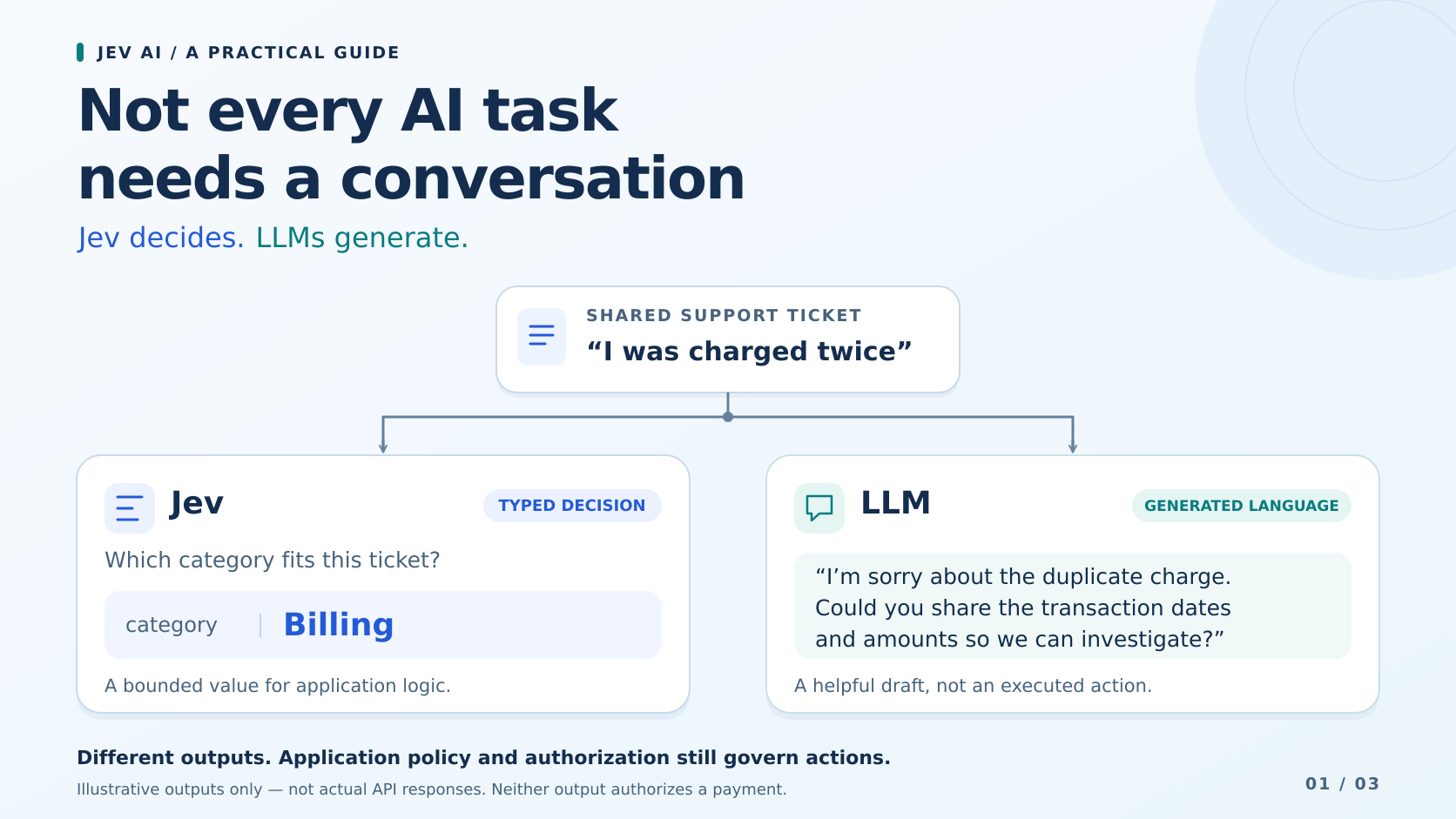
A request has two important parts. The state is the information to read, such as a ticket and relevant account records. The questions define what to evaluate. Several independent questions can share the same state and be evaluated in parallel.
Pick from a list
Billing, technical support, or account access?
Assess against a scale
How urgent is this, using a defined rubric?
Estimate a truth probability
Does the customer explicitly ask for a refund?
“Noul” is TypeSafe’s name for a probability-valued true/false answer. Choice and Score also return probability distributions and a confidence statistic. The distinction matters: confidence is not a guarantee of correctness, and Noul does not have the same separate confidence field.
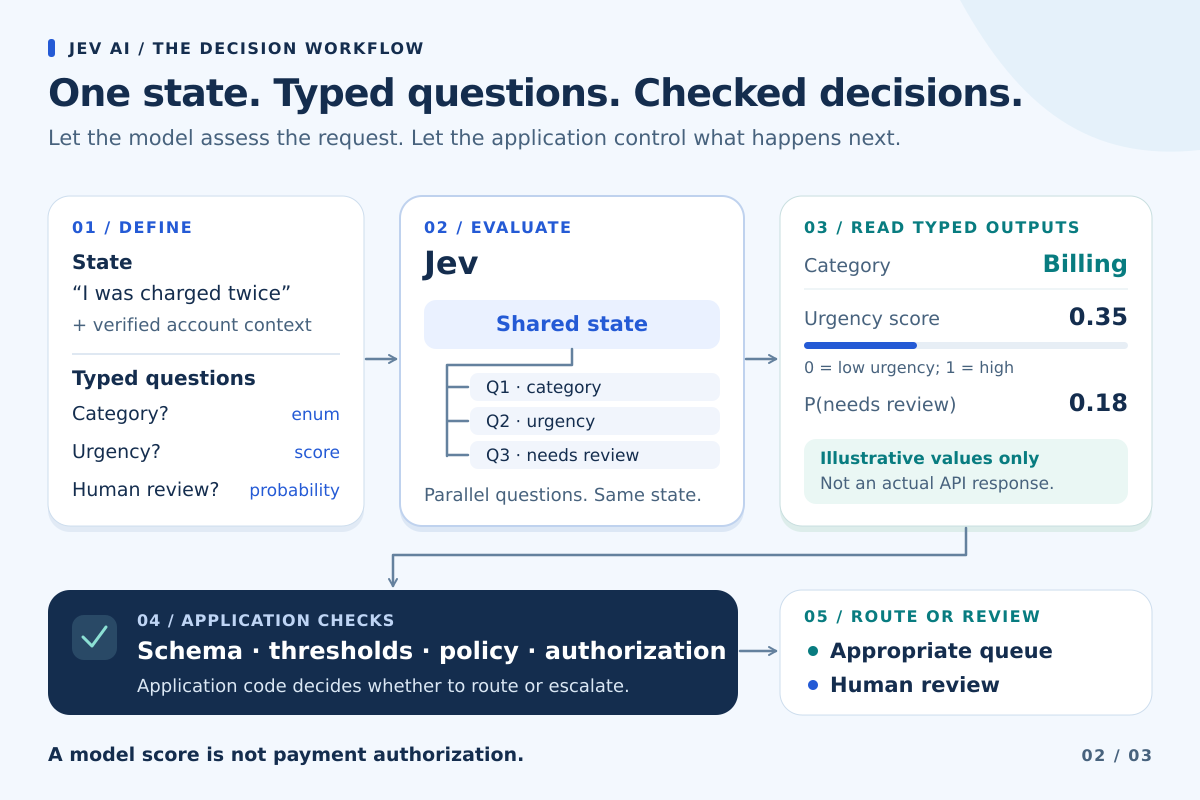
How is Jev different from an LLM?
The difference is not “smart AI versus simple AI.” It is about the work each model is designed to do. Asking Jev to write a project report would be the wrong tool choice. Asking a large generative model for a single routing label may be more machinery than the task needs.
| Question | Jev | Generative LLM |
|---|---|---|
| Main job | Evaluate a predefined decision | Generate language, code, or structured answers |
| Typical result | A choice, score, or probability | A reply, explanation, code, or schema-constrained JSON |
| Question shape | Which queue? How urgent? Does this match? | Explain this. Write a reply. Help debug this. |
| Uncertainty | Probability distributions; confidence on Choice and Score | A written confidence claim is not automatically calibrated |
| Input | Text, including JSON and arrays of text | Depends on the model; some also accept images/audio |
| Best place in an app | Classification, routing, rubric-based assessment | Conversation, synthesis, explanation, generation |
There is an important catch in this comparison: LLMs can already return structured JSON. You do not always need to parse a rambling paragraph. Jev’s proposition is a decision-focused interface, training objective, and pricing—not the invention of structured outputs.
TypeSafe describes its training approach as Reinforcement Learning for Calibrated Decisions (RLCD). In simple terms, the aim is for probability estimates to match observed outcomes across many examples. If predictions assigned 80% probability are correct roughly 80% of the time on representative data, that is useful calibration. It still does not tell you which individual answer will be wrong.
Three examples where this becomes useful
1. The support inbox: route first, write second
Return to our duplicate-charge message. Jev can classify it as billing, assess urgency, and check whether the user is asking for a refund. Your app can then send it to the billing queue. If a personalised reply is useful, an LLM drafts it from verified facts.
Notice what has not happened: the model has not proved that two settled charges exist. That requires transaction records. A refund still needs policy checks, authorization, and protection against paying twice. Understanding a request is not permission to execute it.
2. A student project assistant: find the right kind of help
A student writes, “My FastAPI app says connection refused when I start PostgreSQL.” A project assistant could use Jev to route the question to database setup rather than UI design or viva preparation. Then an LLM explains the likely causes using the project’s actual setup instructions.
This is a proposed design, not a claim that Projiverse already uses Jev. The useful split is easy to remember: Jev helps choose the help path; the LLM teaches.
3. A project-report checker: flag gaps without pretending to grade perfectly
Suppose a college tool checks whether a report discusses its dataset, evaluation method, limitations, and ethical considerations. Those can be separate questions over the same report text. Missing or ambiguous sections go to a reviewer; an LLM can suggest clearer wording.
Do not confuse “the report mentions accuracy” with “the experiment is valid.” Check the underlying evidence, evaluate the system against instructor-labelled examples, and keep a person responsible for final academic judgments.
Token cost: what do you actually pay?
A token is a chunk of text—not necessarily a whole word. Many model APIs charge separately for the text they read and the text they generate. Prices below are in US dollars and were checked on 22 September 2026.
TypeSafe lists Jev 1.13 at $0.042 per million input tokens, with output tokens free. That is $42 per billion input tokens. Free output does not mean free requests, and it does not turn Jev into a free text generator.
For a grounded comparison, let’s use two established small LLMs rather than only expensive flagship models. These are price references, not a claim that they are the newest or that all three achieve the same accuracy.
| Model | Input | Output | Example: 100,000 requests |
|---|---|---|---|
| Jev 1.13 | $0.042 | Free (typed answers) | $4.20 |
| GPT-4o mini | $0.15 | $0.60 | $21.00 |
| GPT-4.1 mini | $0.40 | $1.60 | $56.00 |
Linear scale starting at $0. Calculated API charges only—not measured performance or equal-accuracy results.
The arithmetic is simple: requests × ((input tokens × input rate) + (output tokens × output rate)) ÷ 1,000,000.
- Jev: 100 million input tokens × $0.042 per million = $4.20.
- GPT-4o mini: $15.00 input + $6.00 output = $21.00.
- GPT-4.1 mini: $40.00 input + $16.00 output = $56.00.
In this particular example, Jev’s model bill is 80% lower than GPT-4o mini’s. That is not an 80% saving on your whole app. A shorter LLM answer, cached prompts, batch processing, different accuracy requirements, or more escalations can change the result.
For a tiny workload of just 1,000 requests, the same totals are $0.042, $0.21, and $0.56. At that scale, engineering time may matter much more than the token bill.
Promotion caveat: at the time of writing, Vercel AI Gateway advertises free promotional Jev pricing ending 25 September 2026. The table deliberately uses TypeSafe’s direct API list price, not that temporary offer. Check the provider you actually use.
Execution cost: the token bill is only one line
“How much does it cost to run?” is a bigger question. A real workflow may pay for hosting, databases, retrieval, queues, logs, OCR, retries, and human review. Faster model responses can reduce waiting, but they do not automatically reduce your cloud invoice by the same percentage.
Total workflow cost ≈ model calls + application infrastructure + external tools + retries/fallbacks + review and maintenance.
Here is a deliberately hypothetical budget. Say Jev handles triage for all 100,000 requests, but 20% also need a GPT-4o mini call with the same token assumptions. The model charges become $4.20 + $4.20 = $8.40. If shared infrastructure costs another assumed $5, the subtotal is $13.40 before human review and other expenses. Those $5 and 20% figures are examples, not vendor quotes or measured results.
Now suppose every request needs the LLM anyway. You would pay $4.20 for Jev plus $21.00 for the LLM: $25.20. Adding a routing model has increased model cost. It may still improve control, but it has not saved tokens.
The same caution applies to speed. TypeSafe publishes dramatic speed and cost claims for selected System One workflows. Treat those as vendor benchmarks, not a universal promise or a result we reproduced. Measure end-to-end latency, including network time, queuing, retries, and any follow-up LLM call. Track both the median and the slowest 5% of requests.
The practical answer is often Jev plus an LLM
You do not have to pick a side. Start with ordinary code for exact rules. Use Jev where interpreting messy language is useful. Call an LLM when somebody needs an explanation or a new piece of writing. Send uncertain or high-stakes cases to a person.
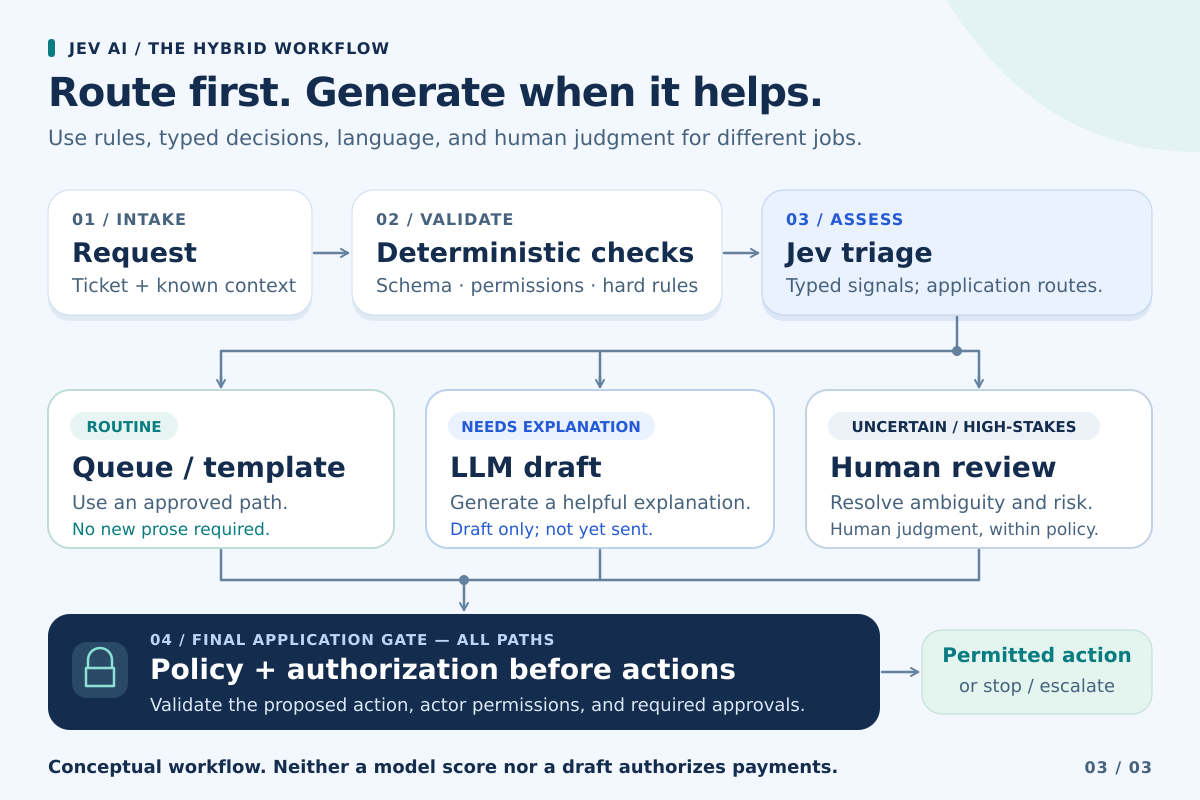
- Validate first. Check permissions, required fields, and exact business rules in code.
- Ask focused questions. Give Jev relevant context and explicit answer choices. Avoid one vague “is everything okay?” question.
- Route by evidence and risk. Tune thresholds on labelled examples from your own workload. Do not copy a magic confidence number from a demo.
- Generate only where needed. Use an approved template for routine messages and an LLM for explanations that need flexibility.
- Check before acting. Validate outputs, enforce policy, request approvals where necessary, and log outcomes without leaking sensitive data.
What should you be careful about?
Typed output solves a formatting problem, not the entire reliability problem. A perfectly valid category can still be the wrong category. Missing context, ambiguous instructions, and malicious text can still lead to bad decisions.
Jev currently accepts text only. Images or audio need a separate preprocessing step, which adds cost and possible errors. Its documented limits are 64,000 tokens across the full request and 32,000 for the state plus the longest question. English is its strongest documented language; test other languages and mixed-language messages yourself.
For repeatable evaluations, pin a model version rather than silently following a moving alias. Compare Jev, a small LLM with structured output, and a rules-only baseline on the same held-out examples. Measure routing accuracy, important false negatives, abstention rate, total cost per correctly handled request, and latency—not just a provider’s price per token.
The takeaway
Jev is interesting because it challenges a habit: sending every AI task to a text generator. Sometimes the useful answer is a sentence. Sometimes it is simply “billing,” plus enough uncertainty information for your software to decide what to do next.
For your next project, start with the job, not the hype. Use code for exact rules, Jev for focused judgments, an LLM for language, and people for decisions that deserve human responsibility.
Sources and pricing notes
This guide uses primary documentation checked on 22 September 2026. Examples, diagrams, and cost scenarios are illustrative; we did not run a comparative model benchmark. Pricing and availability can change.
- TypeSafe: System One concepts and output primitives
- TypeSafe: Jev version, pricing, limits, and supported inputs
- TypeSafe: probability versus confidence
- TypeSafe: launch announcement and vendor benchmark claims
- OpenAI: GPT-4o mini pricing and structured outputs
- OpenAI: GPT-4.1 mini pricing and capabilities
- Vercel AI Gateway: Jev promotional pricing